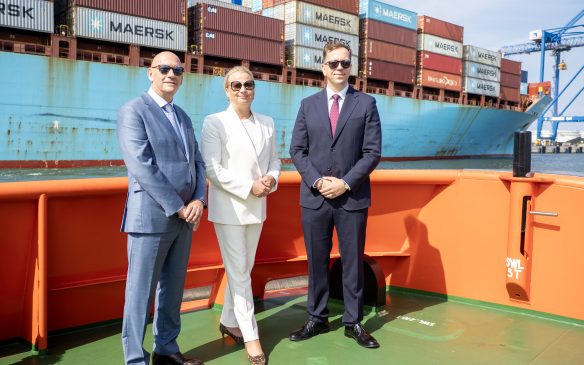
First phase of the GAT has now been completed. This is a strategic investment for Polish exports
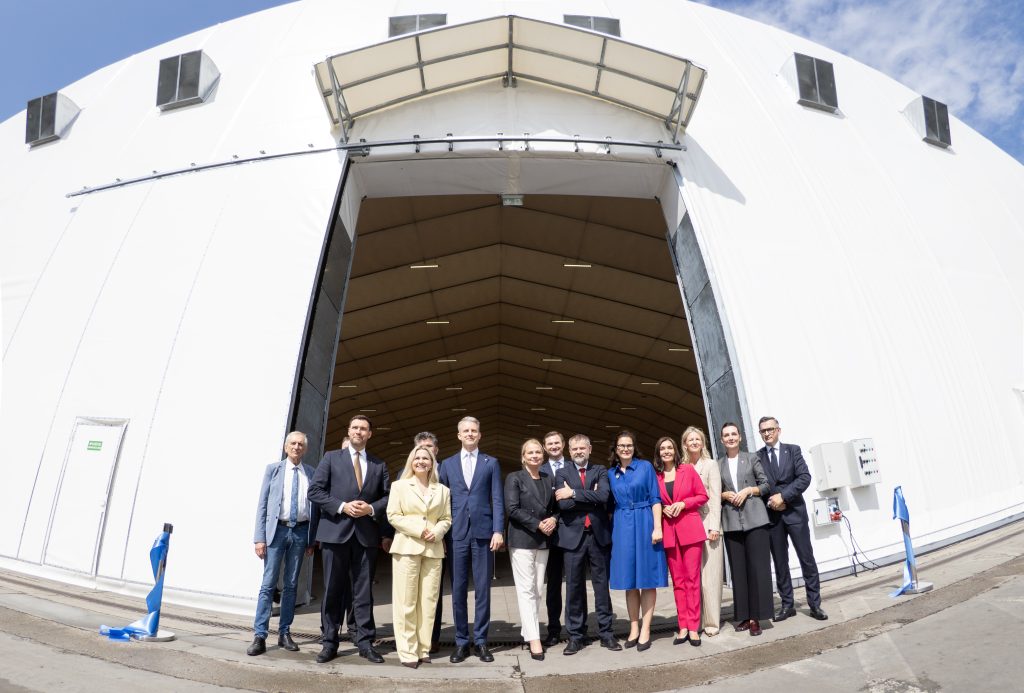
The first phase of the Gdańsk Agro Terminal (GAT) – one of the most important investments in recent years in the agri-food and logistics sectors – has been completed at the Port of Gdańsk. The project carried out by Port Gdański Eksploatacja S.A., a company within the group of companies forming Port of Gdańsk Authority S.A., is extremely important when it comes to increasing Poland’s export potential and strengthening the country’s food security.
The new grain terminal will significantly increase the port’s cargo handling and storage capacity, in response to the growing needs of the agri-food market. The investment has been divided into two phases – and the first one has just been completed. The second phase, involving the construction of silos and further expansion of the infrastructure, is expected to be completed by 2029.
‘We are launching another strategic investment that not only increases Poland’s export potential but, above all, strengthens our food security. Modern ports are not just about the economy or energy, but also about military and food security – and it is precisely in these areas that we invest record amounts today. It is important to note that the terminal is 100% Polish, built by Port Gdański Eksploatacja, a company owned by Port of Gdańsk Authority S.A. and thus by the State Treasury. We are completing the first phase of the investment, and at the same time commencing the next – the construction of a series of silos to further increase cargo handling capacity. This is a project of strategic importance, carried out in partnership with the Ministry of Agriculture and the Ministry of State Assets. Only thanks to such synergy can we effectively support key sectors of the economy and achieve the state’s ambitious goals’, said Arkadiusz Marchewka, Deputy Minister of Infrastructure, during the official opening of GAT.
Modern infrastructure and increased capacity
The first phase of the investment involved the construction of a flat-storage warehouse on Szczecińskie Quay, with an area of nearly 6,500 m² and a volume of over 93,000 m³. Its storage capacity is 30 thousand tonnes, and its cargo handling capacity is 0.5 million tonnes. The facility can handle up to 120 vehicles a day, and its daily cargo handling capacity is 8 thousand tonnes.
One of the greatest advantages of the newly built 140-metre-long storage facility is its modern, single-bay steel structure, which provides a span of almost 50 metres without internal columns. This means that the entire warehouse area can be used efficiently, making cargo handling smoother and less restricted. The facility also stands out for its flexible layout. The use of movable partitions allows it to be divided into two or three independent storage zones, making it possible to adapt the storage facility for different types of goods in storage and current operational needs.
The project was carried out under a ‘design-and-build’ contract, and its value amounted to nearly 14 million zlotys. The contractor for the project was Premium Quality Care.
The second phase of the project assumes the construction of a complex of 24 flat-bottom silos on Wiślane Quay, integrated with an advanced, highly automated cargo handling system. This infrastructure should make it possible to handle cargo transported by ship, rail and road, and also takes environmental and social aspects into account. The technological solutions implemented are designed to reduce emissions, minimise the risk of fires and explosions, and improve the quality of the stored products. Once completed, GAT’s total storage capacity is to increase to 150 thousand tonnes, with its cargo handling capacity reaching 3 million tonnes per year.
A strategic response to market needs
The implementation of GAT is part of a broader strategy to boost the competitiveness of Polish agriculture on international markets. For years Poland has maintained a structural surplus in cereal production – amounting to around 35–36 million tonnes per year, with domestic consumption at 25–26 million tonnes. In this context, the development of the export infrastructure is crucial for the stability and growth of the market.
‘This is a long-awaited investment. The experiences of recent years, linked to the surplus of grain produced by Polish farmers, have shown just how much we need modern infrastructure to enable efficient exports. This allows us to enter new markets, such as in Asia and Africa, where Polish grain has great potential. We focus on cooperation and building strong Polish capital. We are already preparing to launch the first shipment to Egypt, followed by further shipments to Indonesia, Singapore, Malaysia and Vietnam’, said Małgorzata Gromadzka, Deputy Minister of Agriculture and Rural Development.
Experts and government officials emphasise that what matters most today is not just the volume of production, but above all access to markets and efficient logistics. It is port and transport infrastructure that determines the competitiveness of the entire supply chain.
‘Around 40%t of Polish agricultural production is exported, and competition today takes place not only between farmers and businesses in the agri-food sector, but also between ports. As the Ministry of Agriculture and Rural Development, we act as a form of trade representative for Polish food – we build relationships and open up markets so that Polish products find buyers all over the world. However, for these exports to be successful, we must ensure efficient and swift logistics’, said Adam Nowak, Undersecretary of State at the Ministry of Agriculture and Rural Development.
Today the challenge is no longer simply the production of high-quality food, but rather finding stable markets for it, as this has a direct impact on prices and the economic security of farms. It is also crucial to continue developing infrastructure in the interior of the country, particularly rail transport, which should reduce the high costs of grain exports, especially from south-eastern Poland.
It is estimated that grain exports by sea currently amount to 6–8 million tonnes per year, of which around two-thirds are handled by Polish ports, mainly the Port of Gdynia.
Poland: Europe’s breadbasket
As representatives of the government administration emphasise, the development of export infrastructure also marks a return to Gdańsk’s historic role as one of Europe’s most important centres for the grain trade.
‘All this happened back in the 16th century. Grain was transported from here, from Gdańsk, to the whole world – and above all to Europe. Today, we simply return to tried-and-tested practices’, said Grzegorz Wrona, Deputy Minister for State Assets. He also added that partnership between public institutions and state-owned companies is crucial for building a strong economy that competes effectively on international markets. ‘Today it is not just farmers or companies that compete with one another, but entire economies. The wealth of citizens and the rate of GDP growth depend on their strength’.
Aleksandra Dulkiewicz, Mayor of Gdańsk, also highlighted the importance of diversification and strengthening the country’s resilience. She expressed her gratitude for the development of new export markets and for measures to enhance the country’s economic and energy security through investments carried out at the Port of Gdańsk.
Strengthening the position of the Port of Gdańsk
The commissioning of the first phase of the Gdańsk Agro Terminal marks an important step towards the further development of the Port of Gdańsk as one of the key logistics hubs in the Baltic Sea region, ensuring food security. The investment not only increases Poland’s export potential, but also has a positive impact on the development of the entire supply chain – from agricultural manufacturers, through transport, to the ancillary services sector.
‘The Gdańsk Agro Terminal is a project that strengthens the country’s competitiveness, food security and the role of the Port of Gdańsk as the main export gateway for Polish agricultural and food products as well as a key link in European and global supply chains. For the Port of Gdańsk, this means an increase in cargo handling capacity and further diversification of the commodity groups it handles’, said Dorota Pyć, President of the Port of Gdańsk Authority.
In the face of growing competition on the international market and dynamic changes in global trade in agricultural raw materials, GAT has the potential to become one of the pillars of Poland’s export infrastructure for the coming decades.
A new-generation integrated logistics hub
Ultimately, the Gdańsk Agro Terminal is set to become a modern, integrated logistics complex, comprising not only silos and warehouses, but also an automated transport and technological infrastructure. The project assumes, for example, the construction of a multi-purpose cargo handling facility for ships, a system for handling railway wagons and road transport, and a system of service bridges linking all the facilities into a single, coherent operational unit.
‘GAT is a strategically justified investment and essential for the development of Polish agricultural exports. The new terminal is set to strengthen the Port of Gdańsk’s position as a key centre for the export of grain and animal feed in the Baltic Sea region’, said Andrzej Kuźmicz, President of Port Gdański Eksploatacja S.A. ‘Diversification of cargo is also important, as is the ability to handle not only grain but also meal and pellets, which translates into greater operational stability’.
***
Grain in the Port of Gdańsk
At the Port of Gdańsk, grains are handled by eight operators: Port Gdański Eksploatacja (PGE), GBT, Magrol, Gdańskie Młyny, Handel i Minerały, Jargut, Speed and Fast Track. In 2025, the volume of agricultural product cargo handling amounted to 2.5 million tonnes. Figures for the first half of this year point to further growth – to 1.3 million tonnes, representing an increase of 13.3% compared with the same period last year.