European ports in a changing landscape – Poland’s success amid industry challenges
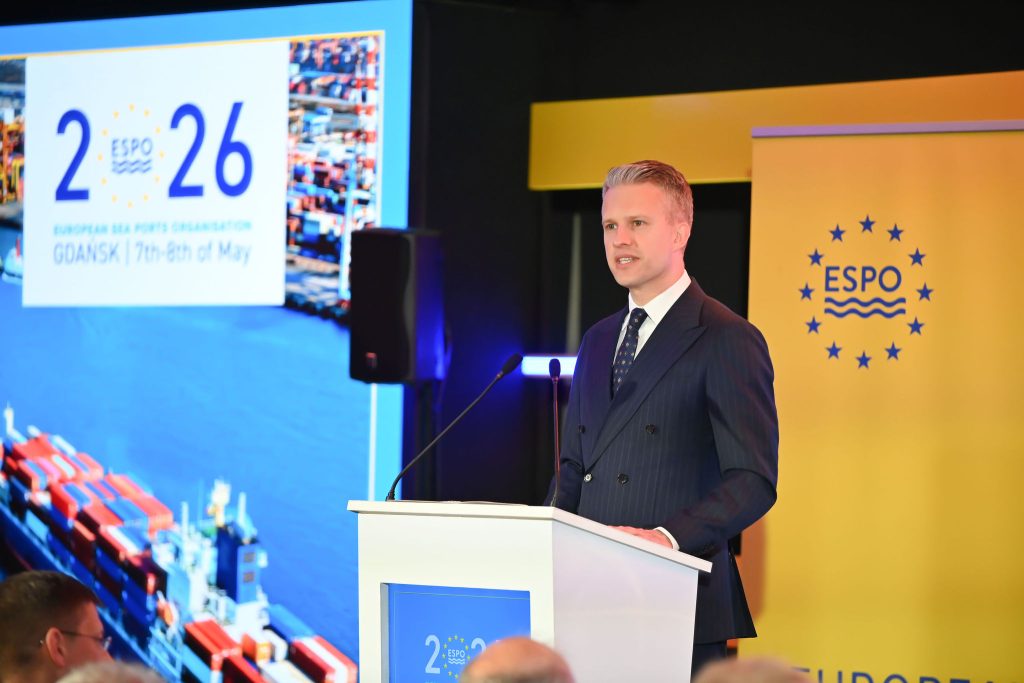
This year’s conference of the European Sea Ports Organisation (ESPO), held in Gdańsk, focused on the key factors shaping the operation of European ports today. Amidst discussions on the effects of geopolitical and economic turmoil, there was also place for a case study of the significant success enjoyed by Polish seaports in recent years.
The conference, which began on 7 May in the hall of the Hilton Hotel in Gdańsk, was opened by the ESPO chairman, Ansis Zeltiņš, who emphasised that in the face of current challenges it is crucial to feel that ports are not facing them alone. He also noted that European ports have entered a decade of profound transformation, and its outcome depends on how the sector addresses risks, what decisions it makes, and what position it takes in the new economic and geopolitical reality. He welcomed the fact that the EU’s new strategy for ports accurately reflects their role, viewing them not only as logistics hubs but also as strategic assets. He also emphasised the need to ensure that ports have the right operating conditions, as it is difficult to expect them to be more resilient and competitive without genuine support and appropriate instruments from the state.
The Deputy Minister of Infrastructure, Arkadiusz Marchewka, referred to the theme of this year’s conference: ‘Competitiveness as a driving force for resilience’. He emphasised that nowadays the competitiveness of ports is much more than just a matter of operational efficiency.
‘Competitiveness builds resilience, and resilience builds security’, said Marchewka. ‘Ports support the continuity of supply, market stability and the safety of citizens. Poland fully understands this responsibility, and Polish ports play an increasingly important role in the European transport system. This is why we continue to invest in their development, upgrade and security, and thus strengthen the resilience of Europe as a whole. The impact of these investments extends beyond our national borders, and increases the security, resilience and competitiveness of the entire European Union.
The Deputy Mayor of Gdańsk, Piotr Borawski, highlighted the importance of partnership – although in a different context. In his speech, he emphasised the role of the relationship between the port and the city.
‘The development of the Port of Gdańsk reflects not only its security investments and innovation, but also a shared vision of openness and partnership. However, ports are much more than just infrastructure. It is an integral part of the city, as it provides jobs, supports local undertakings and helps attract new industries. It also contributes to sustainable urban development’, he said. ‘Such success would not have been possible without strong and effective partnership. The partnership between local government, port authorities and the Polish government is crucial in shaping long-term strategy and delivering major infrastructure projects, as it ensures growth that benefits both the city and the wider economy. This partnership demonstrates how shared priorities and mutual trust make it possible to tap into the full potential of maritime regions’.
MEP Magdalena Adamowicz highlighted the need to move from strategy to action. She emphasised that, in the face of two ongoing wars, industrial and defence infrastructure have become even more intertwined.
‘Transport is the lifeblood of the economy. If we cut it off, the economy dies – and everything else with it. It is difficult to talk about green transport if there is no transport whatsoever’, she emphasised.
She also referred to the measures taken so far and the regulations introduced at the European level, which – in her view – made sense individually, but together had effectively become a mechanism for ‘punishing ports because they are European’. However, a significant change in this approach was brought about by the new European strategy for seaports adopted by the European Commission in March this year.
‘A change in narrative alone is not enough. We need more than just good strategies. We need shock therapy – both swift and wise’, she added.
The outlook for the port sector in Europe was also outlined in detail by Dorota Pyć, President of the Port of Gdańsk Authority, the host of the event. She highlighted the diversity of the challenges facing ports in different parts of the continent.
‘While some ports struggle primarily with the consequences of geopolitical tensions, others face pressure from the energy transition, regulatory changes or growing global competition. Ports in the Baltic Sea region face security issues, while Mediterranean ports suffer the consequences of current events in the Middle East and Africa’, she pointed out. ‘However, all European ports must meet the goals of decarbonisation, digital transformation and rising expectations regarding resilience and sustainability. This diversity of challenges means that partnership, knowledge sharing and coordinated political support are more important today than ever before. The real challenge is not choosing between these priorities, but achieving them all simultaneously’, she added.
The achievement of these goals can be assessed not only on the large scale of global supply chains, energy security or food security for countries or entire regions. As Dorota Pyć pointed out, the Port of Gdańsk itself is a vital component of the national economy and the local community.
‘In recent years, the port’s operations have generated over PLN 40 billion annually in revenue for the state. Thanks to the Port of Gdańsk, there are over 83,000 jobs in the surrounding area, providing livelihoods for over 200,000 people. These figures clearly show that the Port of Gdańsk is about much more than just logistics’.
The first day of the ESPO conference featured yet another distinct Polish highlight. One of the key topics on the agenda was a discussion on the ‘Secret Success of Polish Ports’, although – as the participants pointed out – there is nothing secret about this success. There is no denying this success. The Port of Gdańsk, the largest of Poland’s ports, is now the sixth-largest port in the European Union in terms of cargo handling. Its importance to the region has grown enormously in recent years, as Alan Aleksandrowicz, Vice-President of the Port of Gdańsk Authority, noted at the beginning of the conference:
‘100% of the petroleum products used in Poland pass through our port. We supply 100% of the crude oil to the Polish market. We also supply it to eastern Germany’.
The participants in the discussion, who included representatives from the ports of Szczecin, Świnoujście and Gdynia, as well as the Baltic Hub and GCT container terminals, emphasised the complementary nature of the ports – ranging from the Port of Gdańsk’s strong focus on imports and energy, through the Port of Gdynia’s versatility and focus on exports and imports, to specialised container terminals and developing hubs in West Pomerania, as well as the growing importance of ports in supply chain operations, particularly in light of the geopolitical changes that took place after 2022.
Although there was also discussion of development barriers and problems, with particular emphasis on railway access and the capacity of land infrastructure, as Jan Jarmakowski of GCT noted, all ports on the continent face similar challenges.
The undeniable success and dynamic growth of the port sector in Poland is, of course, linked to the development of the Polish economy and the growing importance of our country on the international stage. This was particularly evident in the remarks of Marcin Kamola from Baltic Hub, the largest container terminal on the Baltic Sea operating at the Port of Gdańsk:
‘Ports are not self-sufficient. They cannot function without their hinterland. So this is not just a success for the ports, but a success for the whole country – a success for Poland, which has seen its economy grow fourfold over the last 25 years’, he said.
Alan Aleksandrowicz also warned that ports cannot rest on their laurels. Constant readiness is required to serve Poland’s ever-growing economy, and this requires investment.
‘When we carried out the last major investment programme in Poland around 2012 and built many rail links, motorways, large tunnels under the Vistula, ring roads and so on, we were convinced that this would be enough for the coming decades, perhaps 20 years or more. It turned out that after just 10 years, all of this had become a bottleneck. The growth in volumes is really high. So far the situation is manageable, but we have almost reached the capacity limit on rail links and motorways. That is why we need to repeat such a massive investment programme’.