The Port of Gdańsk at the International Maritime Congress
Security – a word that was discussed at length during the 12th International Maritime Congress in Szczecin. Today, security is not just about national borders, it is also about supply chains, infrastructure and the ability to respond to a changing world.
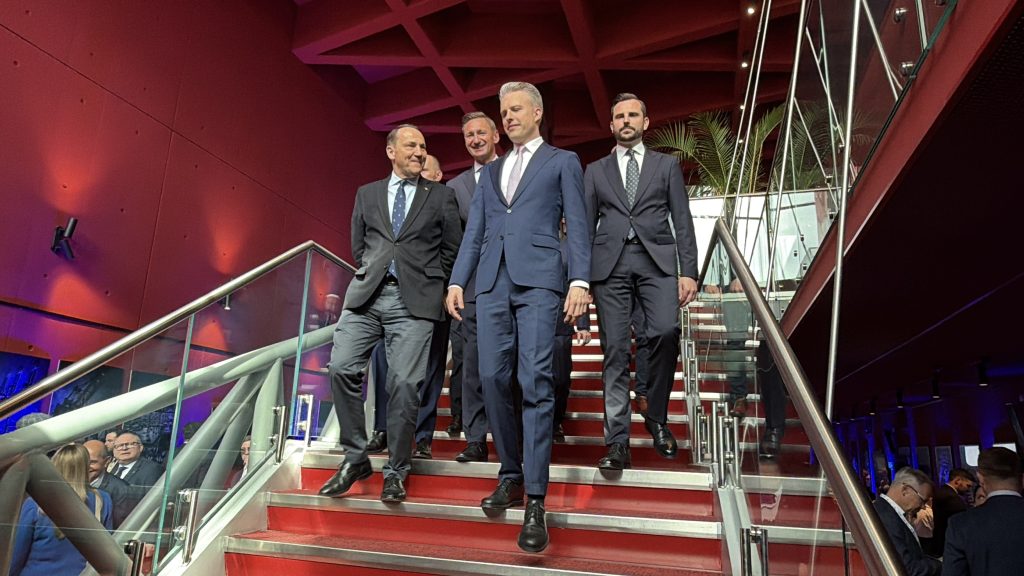
Szczecin once again became the place for an important discussion on the future of Europe and its maritime backbone. Attendance at the event included the Deputy Prime Minister and Minister of Foreign Affairs, Radosław Sikorski, and the Deputy Minister of Infrastructure, Arkadiusz Marchewka. Of course, there were also numerous representatives from the general maritime sector. During the opening ceremony, Radosław Sikorski spoke about security in the context of the international situation and – as he put it – ‘the ongoing global poly-crisis’. Tensions in the Middle East, the blockade of the Strait of Hormuz, Russia’s invasion of Ukraine, and the accompanying economic expansion of a major power like China – these were the issues he focused on in his speech.
Arkadiusz Marchewka, Deputy Minister responsible for maritime affairs at the Ministry of Infrastructure, reported on the pace of development and investment in the maritime sector. The development of ports, the construction of the approach channel to Świnoujście and the construction of what is known as a passing place on the fairway from Świnoujście to Szczecin – these are concrete measures that strengthen not only the competitiveness but also the resilience of the Baltic Sea region.
Geopolitics also presents opportunities
On the second day of the congress, the panel discussions addressed items like the response of ports and shipowners to geopolitical instability, as well as the role of international projects and EU funding in supporting their transformation. Representatives of the Port of Gdańsk emphasised the need to build global relationships and make investment decisions under conditions of high uncertainty – both in terms of geopolitics and technology.
The session on security was attended by Alan Aleksandrowicz, Vice-President of the Port of Gdańsk. The panel discussed the functioning of global shipping amid geopolitical tensions.
Aleksandrowicz emphasised that the development prospects for the Port of Gdańsk remain very good. Both last year and the first quarter of this year ended with record-breaking financial results.
‘Had it not been for the severe frosts at the end of last year, we would have surpassed the 2023 cargo handling figure of 81 million tonnes. We literally needed just a few more ships, which were unable to enter the port due to the weather conditions’, explained Aleksandrowicz.
Geopolitics can create threats that affect all seaports – and Gdańsk is no exception. Unpredictability remains the key issue. Among the challenges highlighted are disruptions to satellite navigation signals, including GPS. In such situations, the rapid and effective exchange of information with operators and the entire port ecosystem is of crucial importance.
The Baltic Sea region remains a particular area of risk, as hybrid warfare activities are reported there, including the destruction of underwater infrastructure. In crisis situations, two priorities remain key: ensuring operational continuity and the rapid restoration of operations in the event of disruption. Ports across the European Union have adopted a similar approach.
‘We all rely on the same EU and international regulations, such as the ISPS Code, the CER Directive and NIS-2. We exchange experiences, although each country implements these regulations in its own way’, said Aleksandrowicz. ‘We rely on the Baltic Ports Organisation, for example, to advocate for appropriate provisions and to ensure that the specific nature of Baltic ports as frontline ports – requiring dedicated financial and regulatory instruments – is taken into account’.
Geopolitical changes can also create new opportunities. The market’s response to the situation in the Middle East was the launch by MSC of a new service linking Europe with the Red Sea. The Port of Gdańsk is one of the European ports on this route, which further enhances its importance in international supply chains.
However, dynamic growth and rising cargo handling also mean new infrastructure challenges.
‘Growth is not keeping pace with the development of inland access infrastructure. Just 10 years ago, we were convinced that such investments as the tunnel under the Martwa Wisła or direct connections between terminals and motorways would suffice for decades. Today we know that we have already reached our full capacity’, said Aleksandrowicz.
In terms of future development trends, changes in the structure of cargo handling are also significant. Coal is not going to disappear from the port in the coming years – major energy companies and combined heat and power plants are still going to need it. The importance of transporting cargo from the automotive sector is also set to grow.
According to Aleksandrowicz, the entire maritime industry should focus more on education and communication in the near future.
‘There is a lack of awareness regarding the impact of ports, the entire transport sector and transport corridors on the development of the immediate, medium-term and long-term environment. This leads to lengthy decision-making processes, and, in a competitive environment, time is of the essence. We must have the opportunity to create a dedicated approach to maritime transport and logistics within the regulations’, said Aleksandrowicz.
No development without partnership
In the panel discussion ‘International partnership delivers significant results for the maritime industry’, the Port of Gdańsk was represented by Michał Stupak, account manager in the Shipping Market Department.
He emphasised the role of international partnership in the context of current and future investments.
‘In fact, virtually all our activities today have an international dimension’, said Michał Stupak. ‘This applies both to academic partnership and participation in projects, as well as strictly business initiatives that support the development of the port and its surrounding area’.
As he pointed out, an important element of this partnership are the international alliances implementing projects in the area of energy transition. The Port of Gdańsk is involved in initiatives related to, for example, the development of renewable energy sources, participation in offshore projects, and the implementation of new technologies used to decarbonise maritime transport.
The panel clearly highlighted the importance of offshore wind energy for the future of the Port of Gdańsk, which is seen as a key installation and logistics hub for the growing number of wind farms in the Baltic Sea.
‘Offshore is one of the most important areas of development’, said Stupak. ‘We are talking about investments that are not only going to change the port itself, but also influence the entire economic ecosystem of the region’.
Another key area of partnership involves initiatives related to the implementation of onshore power supply (OPS) systems for ships moored in the port. In this context, the Port of Gdańsk seeks the best technological and organisational solutions, drawing on the experience of Western European ports and Scandinavian partners.
The issue of future fuels for maritime transport is also significant. The lack of clear technological conclusions – whether LNG, hydrogen or other solutions will dominate – means that ports have to make investment decisions amid considerable uncertainty.
‘This is a key strategic question for us’, he added. ‘The direction of our investments and the development of port infrastructure depend on the types of fuels used in the future’.
A representative of the Port of Gdańsk also highlighted the importance of business relationships built on the international stage. The port develops contacts in Asia and the United States, for example, by organising meetings and initiatives as part of the ‘Business Mixer’ series, designed to attract investors and strengthen the port’s position in global supply chains.
In his view, international partnership is today not only an opportunity but a prerequisite for effective development. It allows not only obtaining financing but also gaining access to knowledge, technology and proven solutions.
‘Without this partnership, it would be difficult to implement such advanced projects as the ones facing ports today’, said Michał Stupak.