The next step in the development of a modern border control centre at the Port of Gdańsk
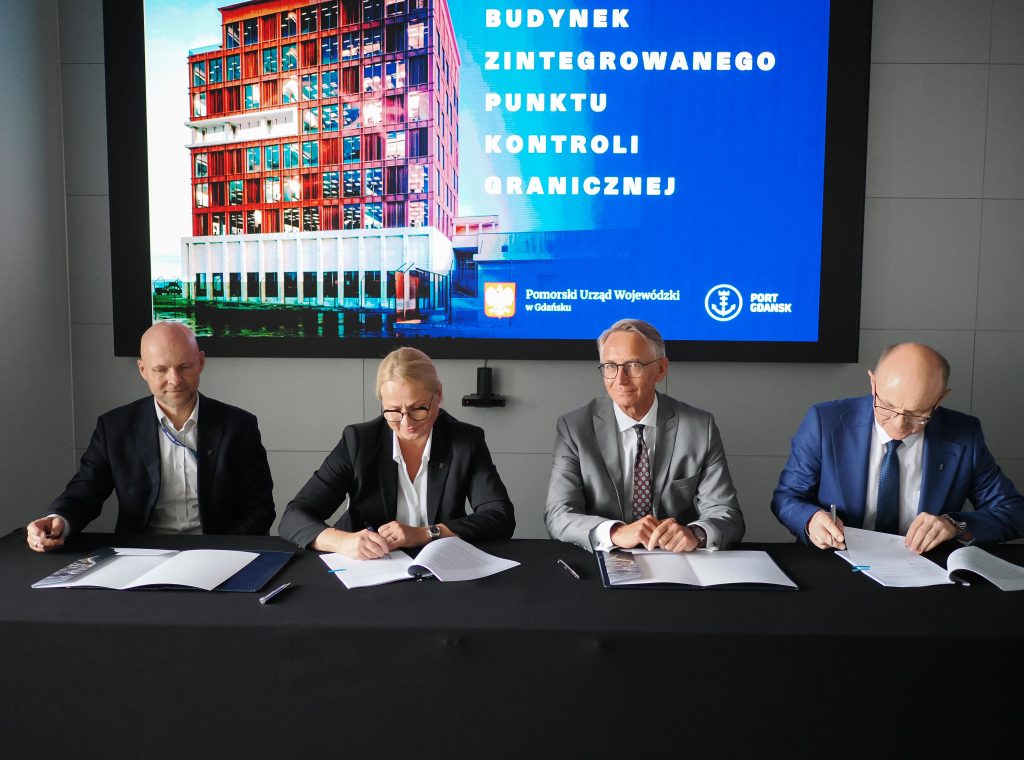
A modern Integrated Border Control Point (ZPKG) is to be built on a 2+ hectare plot inside the Port of Gdańsk. The project, situated on Kontenerowa Street in the immediate vicinity of the Baltic Hub terminal, has been designed to bring inspection services together in a single location and improve the handling of rapidly growing cargo volumes.
The project preparation process is underway and comprises a series of successive stages. The first of these was the signing, on 28 May 2025, of an agreement between the Governor of the Pomorskie Province and the Port of Gdańsk Authority S.A. concerning the preparation of design and cost estimate documentation. This was followed by a tender procedure in which six bidders took part. As a result, the planning and design company, Transprojekt Gdański Sp. z o.o., was selected, and on 6 August 2026 a contract was signed with the company to prepare the design documentation, obtain the necessary permits and administrative decisions, and provide multi-disciplinary design supervision over the implementation of the project. The deadline for completion of the contract has been set for 14 September 2028.
All control services in one place
The Integrated Border Control Point is a project of strategic importance, not only for the Port of Gdańsk but also for the entire Polish maritime economy. By bringing the control services together in one place, the port sector can expect tangible improvements in customs clearance and border procedures, and thus greater efficiency in handling the ever-increasing volumes of goods.
Today the inspection services operate in various parts of Gdańsk, working under a decentralised single- and two-shift model. The Integrated Border Control Point (ZPKG) are planning to consolidate their operations in a single, modern facility. The premises will house, for example: the National Revenue Administration, the Border Veterinary Inspection (GRIW), the Border Sanitary and Epidemiological Station (GSSE), the Provincial Plant Health and Seed Inspection Service (WIORiN), and the Provincial Agricultural and Food Quality Inspection (WIJHARS). A total of 235 people are expected to work on a single shift.
‘The port handles imports, exports and transit, and all these areas are of immense importance, for both the region and for the country as a whole. Imports generate customs revenue and contribute to the state budget, and efficient clearance procedures directly translate into the attractiveness of the Port of Gdańsk, an increase in cargo handling and higher revenue from port charges. We also consider it crucial to ensure appropriate working conditions for the services and the administration – both at the provincial level and at the central government level. Although the Port of Gdańsk is formally the investor, as the landowner and the entity responsible for obtaining the necessary approvals, the project is funded from the state budget. The facility is to be used by state services’, said Emil Rojek, First Deputy Governor of the Pomorskie Province.
Border checks are to be carried out at the Integrated Border Control Point (ZPKG) on goods entering the EU, mainly via the Baltic Hub container terminal.
‘The Integrated Border Control Point is an investment that brings inspection services together in one place and speeds up controls, which translates into greater efficiency and safety of operations at the Port of Gdańsk. This project is important not only for the port, but for the economy as a whole – strengthening our logistical security and competitiveness. We consistently implement projects that build the resilience of the Port of Gdańsk and its position as a modern, sustainable hub in international maritime trade’, said Dorota Pyć, President of the Port of Gdańsk Authority.
Modern infrastructure
The construction site has already been prepared and is ready for the ground-breaking ceremony. In accordance with the architectural concept developed by FOGO Architekci architectural studio, ZPKG is to consist of a 9-storey office building and a 3-storey border control building. Opposite the border control building a roofed area has been designed, with a staff room for security check personnel. The roof of this building includes a car park for 230 staff vehicles, accessible via an external, covered spiral ramp situated between the buildings. It is to be connected to the office block via a link on the third floor.
The development site is to be fenced off, with four entrances from the internal port road. A direct link to the Baltic Hub terminal will also be established – tractor units carrying containers destined for control are to pass through two gates. Security checks are to take place beneath the ramp, with full physical checks inside the building. The project also provides for the installation of renewable energy sources and the option to feed surplus energy into the grid.
The cost of Phase I, involving the preparation of documentation, is PLN 3.5 million net. Phase II, covering the construction and fitting-out of the facility, is PLN 163 million net. Construction is expected to begin in the first quarter of 2029.