First three quarters of 2026: Over 6 million tonnes more cargo than last year. The Port of Gdańsk breaks records
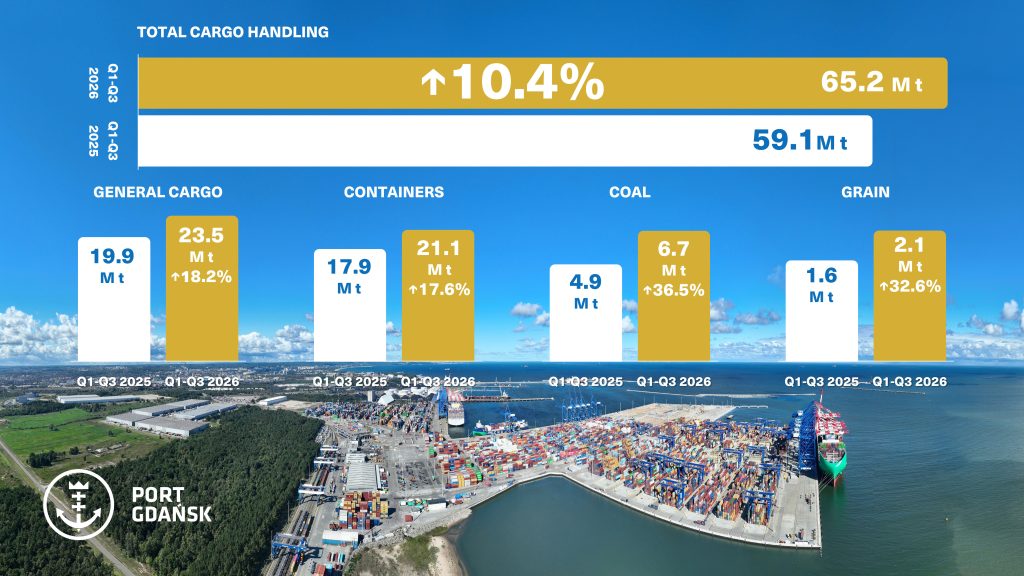
Port of Gdańsk maintains an upward trend in cargo handling. In the first nine months of 2026, the Port of Gdańsk handled 65.2 million tonnes of cargo, compared with 59.1 million tonnes handled in the same period of 2025. General cargo, particularly containerised cargo, accounted for the largest share of the result and remains one of the main drivers of the port’s growth. The increase of over 10 per cent in total cargo handled confirms the growing scale of the port’s operations and its importance in trade.
Liquid fuels constitute the largest cargo group at the Port of Gdańsk, accounting for around 45 per cent of all cargo handled. From January to September 2026, 29.4 million tonnes was handled. This figure remained at a level similar to that achieved the previous year.
The second-largest cargo group is general cargo, which accounts for over 36 per cent. Coal ranks third, accounting for around 10 per cent of cargo handled.
Growth mainly thanks to general cargo
The largest increase in terms of absolute tonnage growth was recorded in the general cargo category. Over the first nine months of 2026, cargo handling amounted to 23.5 million tonnes, which is 3.6 million tonnes more than the previous year. This represents an increase of 18 per cent. Containerised cargo was of particular importance, with volumes reaching 21.1 million tonnes. This is 17.6 per cent more than in the corresponding period of 2025. In terms of TEUs, this represents an increase of 21 per cent, from just over 2 million to nearly 2.5 million TEUs.
Significant growth was also recorded in coal handling, and this trend is also visible in some of the European Union’s largest ports. From January to September, 6.7 million tonnes of this raw material were handled, which is 1.8 million tonnes more than a year earlier. In percentage terms, this represents a 36 per cent increase.
Grain also performed well. As much as 2.1 million tonnes of grain were handled, representing a 33 per cent increase compared with the first three quarters of 2025. Grain terminals handled over half a million tonnes more grain than in the corresponding period last year.
Increases were recorded in almost all the main cargo groups handled by the Port of Gdańsk. The only segment to record a slight decline after the first three quarters of 2026 was the ‘other bulk’ cargo group. Cargo handling in this group amounted to 2.8 million tonnes, which is 1.5 per cent lower than in the same period last year.
The Port of Gdańsk continues to strengthen its position in the region
The growth in cargo handling across key cargo groups, combined with stable performance in the liquid fuels segment, confirms the port’s ability to handle diverse cargo flows and respond effectively to market needs.
‘The results for the first three quarters of 2026 show that the Port of Gdańsk has made effective use of the favourable economic conditions in key market segments and continues to grow in a sustainable manner. This record result was driven by both rising cargo volumes – particularly containerised general cargo – and stable levels of liquid fuel handling, confirming the port’s strategic importance for Poland’s energy security, as well as consistently implemented investments that enhance the port’s operational capabilities and its accessibility from both land and sea. It is precisely this combination of demand for port services, the commitment of our business partners, and the systematic development of infrastructure that allows us to strengthen the Port of Gdańsk’s position within international supply chains. Our priority remains the further development of infrastructure and operational capacity, so that the Port of Gdańsk can respond flexibly to changing market conditions and the needs of our partners’, says Dorota Pyć, President of the Management Board of the Port of Gdańsk.
This year’s results for the Port of Gdańsk for the period January–September show that there is significant potential for further growth, particularly in the containerised general cargo segment, which has for years been one of the main factors strengthening its position. The Port of Gdańsk not only responds to current market needs but also prepares to handle future cargo flows as the most important port in the Baltic Sea region. As cargo handling volumes rise, so does the importance of investments designed to ensure adequate capacity and resilience to future challenges. These investments are to determine the position of the Port of Gdańsk on the logistics map of Europe and the whole world in the coming years.