Offshore Wind Installation Terminal Officially Opens at the Port of Gdańsk
New infrastructure at the Port of Gdańsk will support the development of offshore wind energy in the Baltic Sea. Built on land reclaimed from the Gulf of Gdańsk, the T5 Offshore Wind Installation Terminal has expanded the port by more than 21 hectares. The investment, worth nearly PLN 1.2 billion and supported by PLN 700 million in funding from Poland’s National Recovery and Resilience Plan, is crucial to the efficient delivery of Poland’s offshore wind projects.
The T5 terminal was built in the outer section of the Port of Gdańsk as a direct extension of the existing T1 terminal at Baltic Hub. The project has involved reclaiming land from the sea to create a new 21.3-hectare site. The new site is designed to accommodate the complex logistics operations required to build offshore wind farms in Poland’s exclusive economic zone in the Baltic Sea.
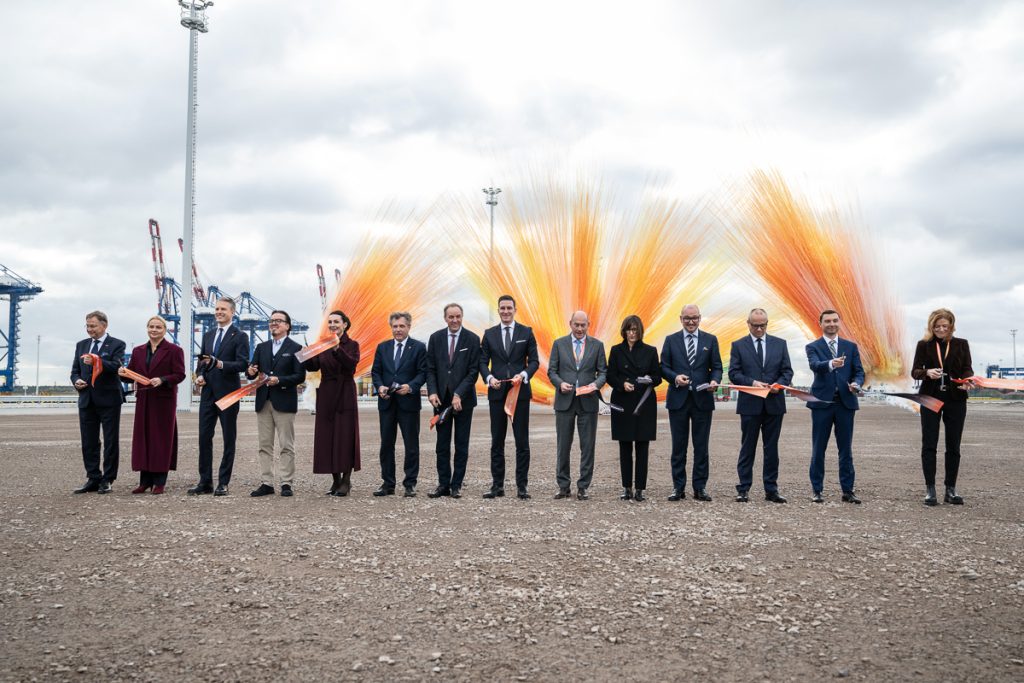
“The T5 terminal stands on land that was underwater until very recently. Poland is now 21 hectares larger. Symbolically, we can say that Poland has not only gained land but also expanded its capabilities in offshore wind energy. Not long ago, we were taking our first steps in this field, while today we are becoming an energy powerhouse in the Baltic region. We want this expansion to translate into greater involvement by Polish companies in projects of this kind. And I can say in all good conscience that this is a genuinely Polish project, right down to the contractor. Our aim was not simply for Poles to build the T5 terminal, which will enable them to play a far greater role in offshore wind projects than before, we also wanted the terminal’s location here to attract many more Polish businesses to work as subcontractors on various aspects of installing these enormous wind turbine towers in the Baltic Sea,” said Prime Minister Donald Tusk at the terminal’s opening ceremony. “Poland is strengthening its position in Europe and emerging as one of the continent’s leaders. Investments like this are possible in part because we are part of the European Union. I hope the T5 terminal will be remembered for years to come as a symbol of sound, purposeful economic thinking, focused on both the present and the future, and as a testament to initiative and courage.”
The new terminal will provide facilities for receiving, unloading and storing oversized wind turbine components, as well as preparing them for onward transport and loading them onto vessels. The infrastructure has been designed to handle exceptionally large and heavy components, including monopiles and other structures used in the construction of offshore wind farms.
“The T5 terminal is a key investment for Gdańsk and the entire region, but it is also of great importance to Poland as a whole. It is a vital part of Poland’s energy transition. Soon, more than 107 wind turbines will be shipped from here for installation at the Baltica 2 offshore wind farm. We want the energy transition to be efficient, bring lower energy prices to Polish families and be underpinned by a carefully considered industrial policy. We want to develop supply chains that enable Polish workers and entrepreneurs to benefit from these substantial investments,” said the Minister of Finance and Economy, Andrzej Domański.
Infrastructure Built for Demanding Operations
One of the terminal’s key features is its quayside infrastructure, designed to accommodate the specialised vessels used in the offshore wind industry.
The outbound quay is approximately 450 metres long and can accommodate the jack-up vessels used in the installation of offshore wind turbines. The inbound quay is approximately 350 metres long. A ro-ro berth, approximately 105 metres long, complements the two quays and will enable the efficient handling of incoming components.
The quays and storage areas have been designed to withstand extremely high point loads, which is particularly important for the storage, handling and preparation of heavy structural components for transport to offshore construction sites.
The terminal has been designed for long-term use. It is expected to operate as an offshore wind installation base for 10–15 years, potentially longer.
“The Port of Gdańsk is taking another major step forward in its development and establishing itself as a pillar of Poland’s energy security. Here, on 21 hectares of land reclaimed from the sea, we will carry out key projects supporting the country’s energy transition. We now have 800 metres of new deep-water quays from which jack-up vessels – specialised ships used to install offshore wind turbines – will depart,” said Deputy Minister of Infrastructure Arkadiusz Marchewka. “Offshore wind farms will generate enough electricity to supply 2.5 million consumers. Ports play a crucial role in ensuring energy security, and that is precisely what we are investing in.”
From the Port of Gdańsk to the Baltica 2 Construction Site
The opening of the T5 terminal is reshaping logistics for offshore energy projects in the Baltic Sea. Until now, components for the Baltica 2 wind farm, being developed by PGE and Ørsted, have been shipped from the Danish port of Rønne on the island of Bornholm. The new infrastructure will allow operations involving the preparation and dispatch of installation components to be carried out in Poland, at the Port of Gdańsk.
Initially, the terminal will provide logistical support for the Baltica 2 project. In subsequent phases, the terminal will also support the BC-Wind project being developed by Ocean Winds. A reservation agreement has already been signed for the use of the terminal.
Access to suitably equipped port infrastructure in the immediate vicinity of offshore project sites is particularly important for the entire supply chain. It helps streamline component transport, reduce logistics costs and minimise the risk of delays to scheduled installation work.
A Key Investment in Energy Security
The development of offshore wind energy is a key part of the transformation of Poland’s energy sector. Further projects in the Baltic Sea are expected to increase the share of renewable energy in Poland’s energy mix, help reduce carbon dioxide emissions and strengthen energy security.
Ports play a strategic role in this process, serving as logistics hubs without which it would be far more difficult to deliver offshore projects efficiently. Suitable quays, storage areas and facilities for handling oversized components are essential to keeping offshore installation work on schedule.
New Opportunities for the Port of Gdańsk
Although the T5 terminal was developed primarily to support offshore wind farm construction, its role extends beyond current energy projects. Once the infrastructure is no longer used to support offshore wind installation activities, the 21.3-hectare site can be repurposed to meet the Port of Gdańsk’s cargo-handling needs at that time.
This is an example of an investment that addresses specific needs arising from the energy transition while also enhancing the port’s growth potential. The new site and specialised infrastructure reinforce the Port of Gdańsk’s position as an important logistics hub for strategic projects in the Baltic Sea.
“Against the backdrop of the ongoing war in Ukraine and global geopolitical instability, security has taken on particular importance. The Port of Gdańsk has a vital role to play in this regard. It is not only a crucial link in European and global supply chains but also a cornerstone of energy security for Poland and the Baltic Sea region. The port’s infrastructure supports the diversification of energy commodity supplies, the development of renewable energy and efforts to make the economy more resilient to external crises,” emphasised Dorota Pyć, President of the Management Board of the Port of Gdańsk Authority S.A. “Today’s opening of the T5 terminal marks more than the completion of another infrastructure project. Above all, it symbolises a bold vision for the future. It demonstrates our ability to deliver ambitious, modern projects that are strategically important to the future of our country, a member of the European Union.”