Port of Gdańsk Business Mixer as a catalyst for redefining Poland’s presence in Japan
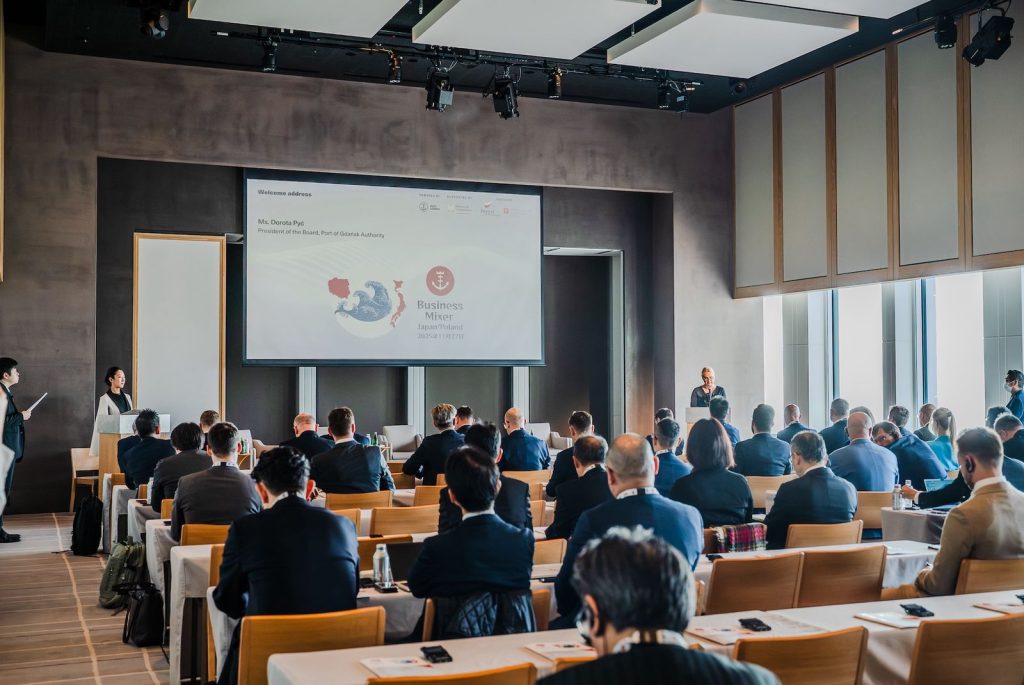
Polish and Japanese maritime and logistics companies met in Tokyo during a Business Mixer, hosted by the Port of Gdańsk. The B2B meetings provided an opportunity to discuss specific projects, needs and potential areas of cooperation, while three panel discussions offered a platform for exchanging knowledge on shared market characteristics and key challenges relevant to developing business relations between Poland and Japan.
On Thursday, 27 November, at Andaz Tokyo Toranomon Hills in central Tokyo, Polish companies showcased their potential and held talks with representatives of Japanese businesses. The Business Mixer provided a dedicated platform for networking and dialogue. Organised by the Port of Gdańsk for several years now across various Asian markets, the event was held, for the first time, in Japan, a country recognised as one of the world’s largest and most demanding economies. While this marked only an initial step, its significance is considerable: Poland is beginning to communicate its economic strengths more proactively in a market where its image has yet to reflect current economic realities.
The Polish economy remains largely invisible in Japan
“Earlier this year, Poland joined the group of the world’s twenty largest economies”, said Mariusz Boguszewski, First Secretary of the Embassy of the Republic of Poland in Tokyo, at the opening of the meeting. He emphasised that the country’s development, modern infrastructure and growing investment potential provide a solid foundation for intensifying economic relations with Japan.
As many participants later admitted, the awareness of Poland in Japan remains surprisingly limited. For this reason, the Business Mixer played a crucial role: it increased the visibility of Polish businesses while encouraging Japanese companies to reassess how much Poland has transformed in recent years.
The event was attended by representatives of Japan’s leading economic sectors, including logistics, maritime transport, manufacturing, technology and energy. According to Hayakawa Tetsua of Japan’s Ministry of Land, Infrastructure, Transport and Tourism, Poland has emerged as one of the most promising partners for cooperation with Japanese enterprises.
“In recent years, the number of Japanese companies active in Poland has grown markedly, while the Port of Gdańsk has emerged as a key hub within the European market. Enhanced cooperation between Polish and Japanese enterprises will improve access to Europe and contribute to the economic growth of both nations”, said Hayakawa Tetsua.
Port of Gdańsk as Japan’s gateway to Europe
Dorota Pyć, President of the Port of Gdańsk, highlighted the port’s strategic importance for international trade. At the opening of the Business Mixer, she noted that the event was taking place at a particularly important moment.
“The Economic Partnership Agreement between the European Union and Japan, concluded in 2018, has enhanced the importance of ports in international trade. As a result, the Port of Gdańsk has reinforced its position as a gateway to the European market for Japanese exporters. The Business Mixer offers an opportunity to take the next step by building direct Polish-Japanese business ties”, she said.
She also cited concrete examples of these synergies, reflecting the increasing commitment of Japanese companies in Poland and at the Port of Gdańsk itself. Among them is one of the most significant joint investments to date: the construction of an FSRU – a floating LNG regasification terminal – which will be chartered from a Japanese company, Mitsui O.S.K. Lines. She also noted that ONE, a shipping operator formed as a joint venture between Kawasaki Kisen Kaisha, Mitsui O.S.K. Lines and Nippon Yusen Kabushiki Kaisha, has launched a feeder service to the Baltic Hub container terminal in Gdańsk.
“Our partnership has the potential to go well beyond trade. Together, we can design solutions that make global logistics more efficient, while also increasing self-sufficiency and resilience”, said Dorota Pyć. “The Business Mixer represents the very essence of cooperation, a platform for genuine partnership”.
She emphasised that Poland and Japan are highly complementary. Poland brings advanced agriculture and food production, while Japan excels in innovation, automotive manufacturing and maritime technologies. As a result, closer cooperation could accelerate a fast and effective energy transition.
Tokyo listens to Poland
A panel discussion bringing together representatives of Nippon Express, Baltic Hub, DSV and Panattoni delivered a clear message: Poland combines modern infrastructure, minimal congestion and competitive costs, yet must communicate these strengths more effectively.
“For most Japanese companies, Hamburg and Rotterdam are well known. These are ports that have been used for years. The majority of Japanese firms rely on them, and this feels natural”, admitted Kazuo Uehara of Nippon Express. “Gradually, as the Port of Gdańsk develops, this is changing, but the long-established perceptions still remain. The Business Mixer is very important for people in Japan to learn more about Poland and the Port of Gdańsk. Everyone should know that Gdańsk is a major hub, with strong inland connections and good accessibility.
Jan van Mossevelde, CEO of Baltic Hub, expressed a similar view, emphasising that Poland and Poles do not promote themselves sufficiently abroad.
“Outside the country, very few people are aware of the scale of progress that Poland has achieved in recent years. This is something that must be communicated globally”, he stressed.
Ukraine featured prominently in discussions on logistics cooperation between Poland and Japan. Despite the ongoing conflict, Japanese companies remain active in trading with Kyiv. Grzegorz Samoć of DSV noted that his company currently handles a substantial volume of transformer shipments from Japan to Ukraine.
“In Japan, the Ukrainian market is regarded as one with significant potential. Once the war is over, it will become a market of unprecedented growth. Demand for a wide range of products, especially infrastructure components, transformers, construction equipment and steel structures, will be substantial”, he stated.
The Business Mixer delivered a clear conclusion: infrastructure alone is not enough. Effective communication and the long-term building of Poland’s brand in Japan are essential.
Time is money? Not in Japan
During the second panel, the participants discussed opportunities for Polish-Japanese cooperation across multiple sectors. Takenaka and Sohbi Kohgei (via Sohbi Craft) are long-established investors in Poland. The speakers addressed what had led Japanese companies to choose this particular region of Europe for their operations. Takeshi Kojima (Takenaka) emphasised the importance of a shared work ethic and similar approaches to project implementation, as well as the role of special economic zones in creating a supportive business environment. Takahiro Matsuse (Sohbi Kohgei) focused on responsibility, creativity and a strong work ethic, recalling how, during the Covid-19 pandemic, an employee proposed launching the production and distribution of face masks, and later, after the outbreak of the war in Ukraine, bulletproof vests.
“For Sohbi Kohgei, the proximity of the Port of Gdańsk was a crucial consideration, one that became even more significant after the outbreak of the war in Ukraine. We were aware of congestion issues in Western Europe, yet the Port of Gdańsk continued to operate smoothly, and we incurred no losses. Supply chains proved resilient, and this became one of the cornerstone factors of our success”, said Takahiro Matsuse.
Marta Szczygieł, representing PAIH in Tokyo, addressed common mistakes Polish companies should avoid when attempting to establish themselves in the Japanese market.
“For example, Polish companies sometimes expect to be given a list of contacts to Japanese companies so that they can approach them directly. That approach does not work in Japan, where business relationships are built through trusted intermediaries. We do not overwhelm Japanese partners with unsolicited emails. Instead, we prepare bespoke enquiries. Only when a Japanese company responds positively do we introduce both sides”.
Szczygieł noted that the purchasing power of Japanese companies is no longer as strong as it once was. If they do decide to enter the European market, their first choice will be partners with an already well-established brand presence in Japan. Cultural differences remain another key consideration.
“Polish companies are used to faster business processes, while Japanese businesses take their time and follow more extensive decision-making procedures. Poles are often impatient because ‘time is money’, but this mindset does not apply in Japan. Once strong relationships are built with Japanese partners, they tend to be durable. We share similar values and approaches to work. Japanese and Polish companies can collaborate easily, provided these initial barriers are addressed”, she added.
Which economic sectors and projects are best positioned to foster partnerships between Poland and Japan? Takahiro Matsuse highlighted Japanese investments in renewable energy, which are gaining momentum in Poland. The semiconductor industry was also identified as a sector with strong long-term potential. Of the nine Japanese projects linked to Ukraine’s reconstruction, seven have chosen Poland as their operational base. This creates substantial opportunities for cooperation in logistics, infrastructure and manufacturing.
Sustainable and resilient development
The final panel addressed environmental responsibility and sustainable development. Alan Aleksandrowicz, Vice President of the Port of Gdańsk, highlighted challenges that include unstable and evolving regulations, a shortage of skilled personnel and geopolitical considerations.
“We aim to be sustainable, environmentally neutral and green, because the port is not only our workplace but also where we spend a significant part of our lives. That said, the challenges are substantial. How do we achieve sustainability in a cost-effective way while remaining competitive? It is important to remember that a port has a mission. The goal is to maintain cargo flows, achieve business continuity and secure energy for the country. These are our priorities. We want to pursue them sustainably, but we must also remain focused on our core mission”.
Yokoshima Naohiko, President of the Japanese government agency NEDO (New Energy and Industrial Technology Development Organization), identified hydrogen and renewable energy as the main pillars of the energy transition. NEDO is already delivering projects that could attract interest from Poland’s port and energy sectors. Naohiko highlighted a pilot project launched in 2022 at the Port of Los Angeles, where energy is generated using Toyota-produced fuel cells. In the long term, NEDO plans to make this technology available to other ports as well. Another promising initiative involves floating wind turbines. Three pilot projects are currently underway off the coast of Japan, with NEDO aiming to develop the world’s first floating wind turbine with a capacity of 15 MW.
Mikołaj Trunin from Invest in Pomerania highlighted that Pomorskie is one of Poland’s leading technology and IT hubs, opening up opportunities for collaboration, particularly in the semiconductor industry. Around 50,000 professionals are currently employed in the region’s IT sector, with universities continuing to train new specialists. The Tricity provides a comprehensive investment environment for semiconductor manufacturing.
One of the most notable investments in Gdańsk in recent years is the Baltic Towers wind turbine tower factory. It was presented by Jakub Wnuczyński, CEO of the company. Although production is already underway, recruitment remains a significant challenge.
“Poland, like Japan, faces demographic challenges, and this creates opportunities for collaboration with Japanese companies in automation and robotics. The goal is to minimise energy costs, and to achieve this we are looking for smart solutions,” said Wnuczyński. He also stated that the factory would be ready to manufacture towers for floating turbines should such an opportunity arise.
Summing up the discussion, Yokoshima Naohiko noted that although the guiding principle of the energy transition based on renewables is to ‘produce locally and consume locally’, the adoption of Japanese technologies could allow Poland to build strong energy resilience within just a decade.
Polish companies showcase their potential
One element of the Business Mixer was the presentation of Polish companies, spanning sectors from logistics and legal services to technology and cosmetics. Businesses showcasing their activities in Tokyo included Baltic Hub, Panattoni, Projmors, Doraco, Polska Grupa Kosmetyczna, BLG, Clurgo, Idego, Balteam and Frach Group. Each had the opportunity to introduce its competencies to Japanese partners and agencies.
“Today, it has been made clear that the awareness of Poland in Japan remains insufficient. It is our role to change that,” said President Dorota Pyć in her closing remarks.
Japan is a demanding yet highly promising market. The Port of Gdańsk has taken the first step. Now it is time for the next.