Port of Gdańsk advances in the cargo handling rankings – now 8th in Europe and 6th in the European Union
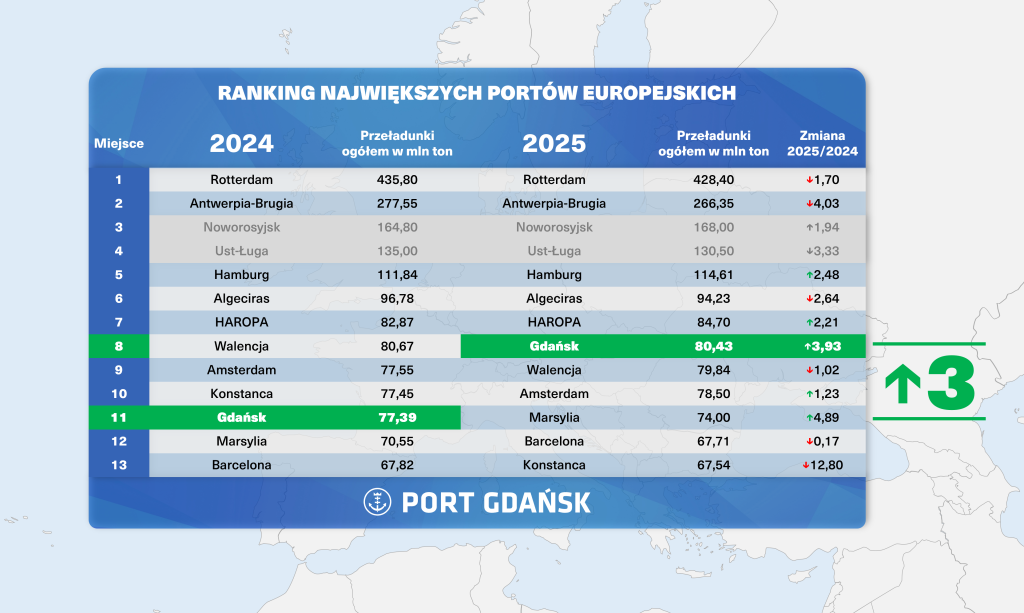
The Port of Gdańsk, which closed 2025 with a result of 80.4 million tonnes of cargo handled, has strengthened its position among Europe’s largest ports. It has advanced to 8th place on the continent and 6th in the European Union, overtaking the ports of Valencia, Amsterdam and Constanta, which recorded lower growth dynamics. This marks an actual rise of three places in the rankings – the most significant among all the ports included in the list.
Among the largest ports in the European Union, Gdańsk is currently ranked 6th, behind Rotterdam, Antwerp–Bruges, Hamburg, Algeciras and HAROPA.
The Port of Gdańsk’s advancement is driven by its growth in key cargo handling segments, with liquid fuels playing a dominant role (39.6 million tonnes, an increase of 0.4%) as well as general cargo, whose volume rose to 27.2 million tonnes (+16.6%), with container handling increasing by as much as 23% to nearly 2.8 million TEUs.
“As the largest seaport in Poland, we build our security and sustainable development on solid foundations. The results achieved in 2025 gives us great satisfaction, especially considering that the port market in Europe is developing unevenly. While some ports are experiencing declines in cargo handling, ports with a stable infrastructure and high operational flexibility are able to harness their potential and build resilience, even in these challenging times. Therefore, Port of Gdańsk Authority will continue its investment plans, pragmatically investing the funds earned in port and access infrastructure,” said Dorota Pyć, CEO of the Port of Gdańsk Authority.
Despite a decrease compared to 2024, the Port of Rotterdam remains at the top of the ranking, handling 428.4 million tonnes of cargo in 2025. The port of Antwerp-Bruges retains second place (266.35 million tonnes, a decrease of 4.03%). The top five also includes two Russian ports: Novorossiysk (168 million tonnes, a 1.94% increase) and Ust-Luga (130.5 million tonnes, a 3.33% decrease), as well as the Port of Hamburg, which closed the year with a result of 114.61 million tonnes and growth exceeding 2%.
This year’s ranking shows varied dynamics among European ports. Some of them, including the Port of Gdańsk, Hamburg and the French ports, are increasing cargo handling despite a challenging market environment. Others, such as Antwerp-Bruges, Ust-Luga and Algeciras, are recording declines. The largest decrease was recorded by the Romanian port of Constanta, which moved from 10th to 13th position.