The new reality for Europe’s ports: between competitiveness and resilience
During the European Sea Ports Organisation (ESPO) conference, which took place in Gdańsk this year, discussions focused on the challenges facing ports in light of the geopolitical, economic and technological changes currently taking place around the world. How should European ports respond to this situation?
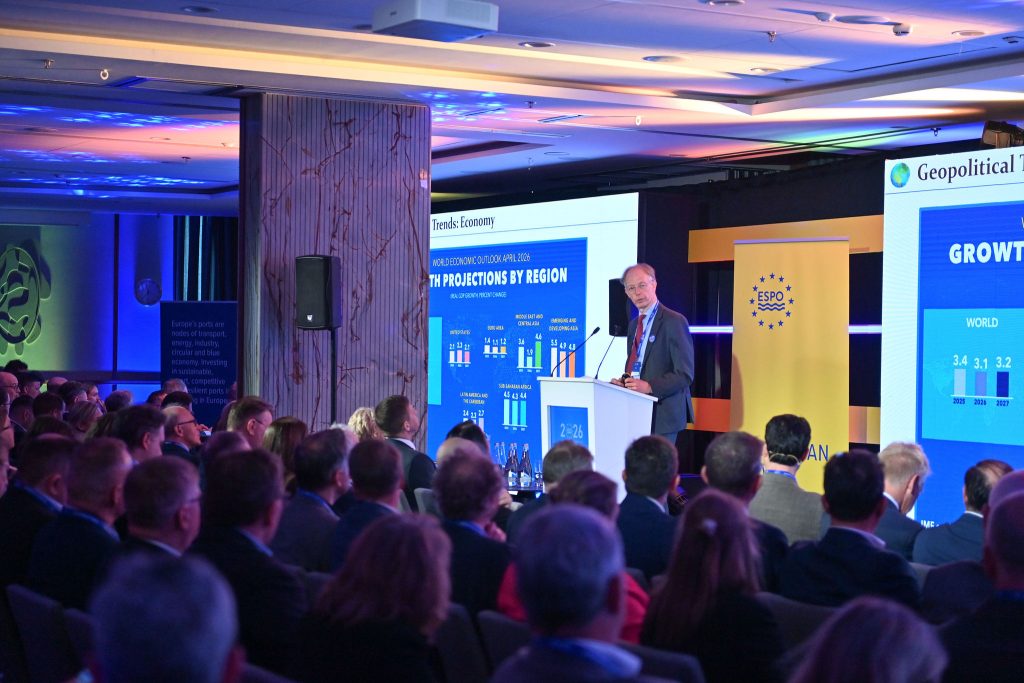
A macroeconomic overview extending beyond the Old Continent was needed to consider the role of European seaports. It was presented by Tim Power of Drewry Consulting. He pointed out that, despite global tensions, the world economy is set to grow at a rate of around 3.2% in the coming years, with growth in Europe expected to be roughly half that figure. However, this growth is highly dependent on the geopolitical situation and the stability of key trade routes. Tim Power also emphasised the importance of crude oil and LNG as fundamental raw materials for the global economy. In the context of maritime trade, he paid particular attention to its resilience, defining it as the ability to cope with disruptions and quickly return to normal.
‘The resilience of maritime trade is based on two elements: capacity and flexibility. If we have both, we can cope with many crises’, he said, and warned that threats to freedom of navigation and rising trade tensions may undermine the stability of maritime transport in the future.
A speech by Ana Maria Jaller-Makarewicz, a representative of the Institute for Energy Economics and Financial Analysis, highlighted the growing instability of global energy markets and the consequences of disruptions to key trade routes.
‘We are currently facing a new crisis. Energy markets are fragile, uncertain and unpredictable’, she noted. She also emphasised the changing nature of risks for the sector. She also commented that any disruption to key shipping routes affects the global energy market, citing the situation in the Strait of Hormuz as an example. ‘We see high price volatility and, in truth, we do not really know what the price will be tomorrow, or even in a few hours’ time’.
She concluded by highlighting the scale of the challenges facing Europe, and pointed to the need to accelerate electrification and the development of renewable energy sources.
In his speech, Alex Krijger, co-founder and managing partner of Krijger & Partners, drew attention to the need for a change in perspective when it comes to our view of the world and economic and geopolitical processes. He emphasised that Europe is currently operating amidst a major transformation of the international order.
‘We are entering a new era in which the world order we have known since 1945 is ceasing to exist’, said Alex Krijger. ‘If we really want to understand what is happening in the world, we should focus less on the West and more on Latin America, Africa and Asia’.
He also pointed out that the world is becoming increasingly multipolar, and demographic, and that economic changes will be of key importance. He emphasised that current tensions and crises could serve as a catalyst for strengthening Europe’s position, provided they are used to redefine international partnerships and build new ones.
Ben Chu, BBC Policy and Analysis Correspondent and author of the book ‘Exile Economics’, has highlighted the growing trend of economic fragmentation and a shift away from globalisation, known as exile economics. In the context of geopolitical tensions and uncertainty, many countries seek to become more self-sufficient.
‘Many countries have come to the conclusion that they must build greater strategic autonomy when it comes to energy, food, critical raw materials, finance and supply chains’, emphasised Ben Chu. ‘Although this drive is understandable, it leads to a reduction in international partnership and a rise in protectionism. The pursuit of self-sufficiency is not the same as security – in many cases, global economic ties strengthen, not weaken, the system’s resilience. An excessive move away from globalisation may result in weaker growth and less stability, as a world of closed fortresses would be poorer, more fragile and less sustainable.
Ben Chu backed up his arguments with statistical data, showing that a country’s access to certain resources does not necessarily mean they are widely available on the local market. On the other hand, dependence on imports does not necessarily translate into a risk of product shortages.
Dr Yasser Zaghloul, President of the NMDC Group from the United Arab Emirates, emphasised in the next part of the conference that current geopolitical tensions in the region have a direct impact on market functioning – particularly through disruptions to supply chains, shipping and rising operational costs. He also noted that, in times of instability, the importance of international partnership and the diversification of supply chains has grown, and that investment in infrastructure and the energy sector – despite the difficulties – remains a key driver for growth and new development opportunities.
Meanwhile, a panel discussion featuring representatives from Europe’s largest ports revealed that geopolitical tensions – including the risk of disruptions in the Strait of Hormuz – have a significant, albeit varied, impact on the port sector and the infrastructure of global supply chains. The key conclusion was the importance of resilience and advance preparation for crises, which – whilst affecting operations and trade – must not distract attention from the sector’s long-term transformation, particularly towards low-carbon energy and new business models. In this context, investment (both public and private), stable and predictable regulations, and enhanced partnership between ports and EU Member States – in terms of both infrastructure and security – become crucial. The panel also pointed out that the future of ports depends largely on the ability to ensure energy security, reduce dependence on external suppliers, and build a European, integrated energy and capital market that can finance the transition and maintain competitiveness.
The second day of the conference began with a session focusing on the key challenges and opportunities shaping the future of ports: growing global competition for critical raw materials and the role of ports in securing them, the transformative impact of artificial intelligence on port management and operations, and institutional support for their development. In particular, the importance of the European Investment Bank’s programme for building the capacity of smaller ports within the TEN-T network was highlighted.
Magda Kopczyńska, Director-General for Mobility and Transport at the European Commission, emphasised in her speech that in the face of growing investment needs, the transport sector – including ports – cannot rely solely on public funds. It is essential to maintain strong support for infrastructure funding at the EU level, and at the same time to develop new instruments to mobilise private capital. She highlighted the need to combine EU, national and private funds more effectively, as well as to make use of guarantee mechanisms and innovative financial tools.
A subsequent debate – involving representatives of the European Parliament – confirmed that strengthening the competitiveness and resilience of European ports requires a coherent, coordinated EU policy combining investment, stable regulation and effective financing mechanisms. The participants concluded that, in the face of a changing global order, Europe must act with greater confidence and consistency, strengthen its position, build new partnerships and recognise ports as a key element of the European economy and security.