Cargo handling at the Port of Gdańsk: liquid fuels in the lead while containers hit a record high
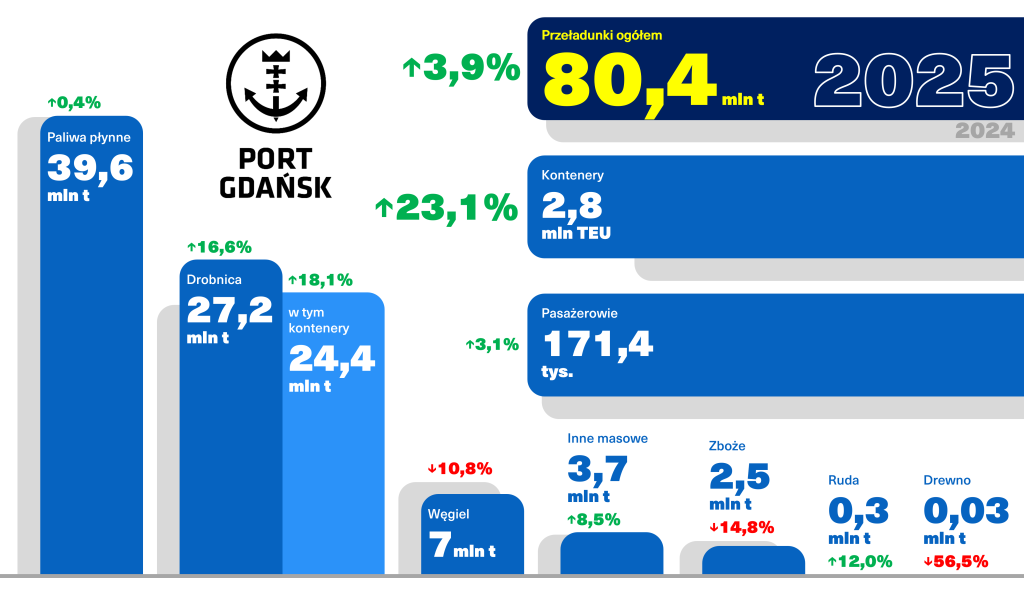
The Port of Gdańsk closed 2025 with a very strong cargo-handling performance, confirming its long-term growth trajectory. In 2025, Poland’s largest seaport handled a total of 80.4 million tonnes of cargo, an increase by nearly 4% year-on-year, compared with 77.4 million tonnes in 2024. These figures clearly confirm the Port of Gdańsk’s position as the fastest-growing port in the region and a key transport hub for Central and Eastern Europe.
In 2025, a total of 4,394 vessels called at the Port of Gdańsk, up 4.2%, year-on-year. The number of commercial vessels reached 3,650, up 2.5% compared with 2024. At the same time, the average gross tonnage (GT) of commercial vessels grew by 3.8%, highlighting the Port of Gdańsk’s growing role in handling larger ships and its effective use of deep-water infrastructure.
Liquid fuels retain their dominant position
Liquid fuels remain the largest cargo group in the overall structure of cargo at the Port of Gdańsk. In 2025, liquid fuel handling reached 39.6 million tonnes, up 0.4% year-on-year, accounting for 49.3% of total cargo handling at the port. As such, liquid fuels remain a cornerstone of the Port of Gdańsk’s operations and a vital component of Poland’s national energy security system. Crude oil handling at Naftoport reached 37.4 million tonnes, compared to 36.6 million tonnes in 2024, marking the highest volume in the terminal’s history. In 2025, Naftoport handled 379 crude oil tankers and 84 other vessels carrying petroleum products, reinforcing its key role in safeguarding energy supply flows to Poland and the wider region.
Containers drive growth
General cargo was the second most important cargo group in 2025 and one of the fastest-growing segments. Its volume increased from 23.3 million tonnes in 2024 to 27.2 million tonnes in 2025, an increase of 16.6%, year-on-year. General cargo accounted for 33.8% of total cargo handling, confirming its growing importance for the port’s continued development. The Port of Gdańsk recorded especially strong performance in the container segment, which remains a key driver of the port’s growth. In 2025, container terminals handled nearly 2.8 million TEU, up 23% year-on-year, including 2,766,475 TEU at the Baltic Hub Container Terminal. At the same time, containerised cargo tonnage increased by 18%, reaching 24 million tonnes. These figures clearly confirm the dynamic development of the Port of Gdańsk and its growing role as an important link in international maritime trade.
Diverging trends
Within the dry bulk cargo segment, the Port of Gdańsk recorded mixed results. Coal handling declined for the second consecutive year, falling by 10.8% year-on-year, to nearly 7 million tonnes, which is approximately half of the volume handled in 2022. Coal accounted for 8.7% of the port’s total cargo structure, confirming its steadily waning importance in Poland’s energy mix.
By contrast, ore volumes increased by 12% to 326,700 tonnes, while other dry bulk cargoes rose by 8.5%, reaching 3.7 million tonnes.
Significant declines were recorded in timber, with volumes down 56.5% to 31,200 tonnes, and in grain, where handling fell by 14.8% to approximately 2.5 million tonnes.
In 2025, a decline was also recorded in the ro-ro segment, with the number of vehicles handled falling by 15% to 118,000 units.
Passenger traffic, however, recorded growth. Last year, the Port of Gdańsk served 171,400 passengers, up 3.1% compared with the previous year. These figures confirm sustained demand for ferry connections and tourist traffic (266 ferry calls and 57 cruise ship calls).
“The Port of Gdańsk’s 2025 results confirm our ability to adapt and build resilience amid changing conditions in international maritime trade and global supply chains. The Port of Gdańsk Authority continues to invest in port infrastructure in a balanced and sustainable way, while actively diversifying cargo streams. Our consistent actions are strengthening the Port of Gdańsk’s position in the Baltic Sea region and across Europe, particularly in liquid fuels and containerised general cargo handling,” said Dorota Pyć, President of the Port of Gdańsk. “As a result of these efforts, the Port of Gdańsk ranks among the key transport hubs in Central and Eastern Europe, influencing its wider environment as a port that is well prepared to meet the growing demand for specialised port services. This is supported in particular by ongoing investment projects, which are laying solid foundations for the port’s continued dynamic, yet pragmatic development.”
Investments driving further growth
In 2025, the Port of Gdańsk recorded strong investment momentum. Naftoport commenced the construction of its sixth liquid fuels handling berth, designed as the second facility capable of handling the largest class of oil tankers worldwide, exceeding 300 metres in length and with draughts of up to 15-17 metres. At the same time, works continued on an offshore wind installation terminal, an FSRU and the expansion of quays in the Inner Port. The year also saw the completion of several investments critical to the port’s development, including the T3 terminal at Baltic Hub and the extension of Bytomskie Quay.
By combining solid operating results with the consistent delivery of major infrastructure investments, the Port of Gdańsk continues to reinforce its role as a leading logistics hub in the Baltic Sea region and an integral part of Europe’s transport network.